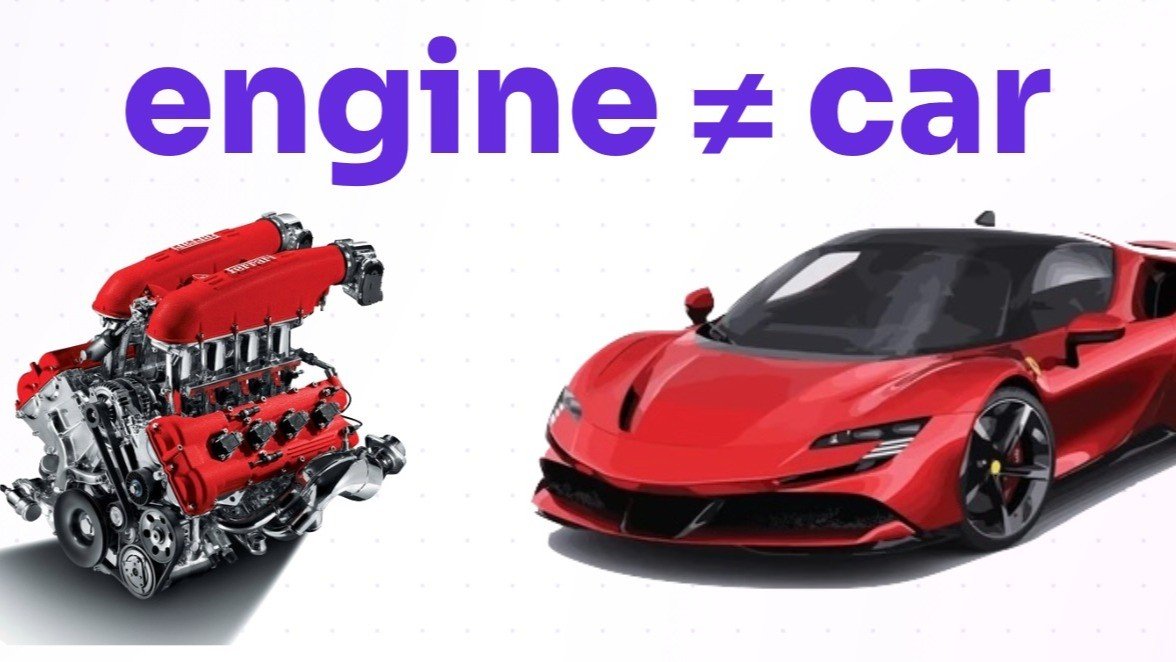


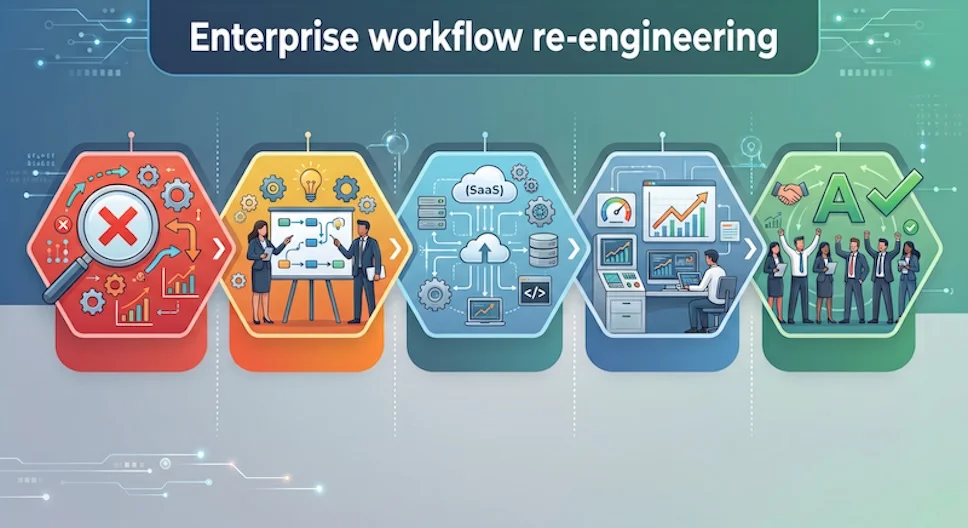
AI models are getting smarter, cheaper, and more accessible. That’s no longer a secret. Every enterprise will have access to powerful AI models. Every software vendor will add AI features. Every employee will have a licensed frontier chatbot or copilot. Model access will not be scarce. Intelligence, at least in its raw form, will increasingly become a utility.
The harder question is not whether an enterprise can use AI but whether it can reimagine how work gets done across teams and departments. That is where most enterprise AI adoption will slow down. Not because the models are weak but because business workflows are messy. Most work does not happen inside neat software UI. It happens across ERPs, spreadsheets, emails, PDFs, WhatsApp messages, shared drives, approval chains, undocumented exceptions, legacy processes, and tribal knowledge.
A reconciliation process may look simple from the outside. Match invoices. Match payments. Flag mismatches. Resolve exceptions. But inside a real business, that workflow may involve inconsistent invoice formats, partial payments, GST mismatches, vendor follow-ups, credit notes, missing documents, delayed entries, manual overrides, ERP quirks, and judgment calls made by people who have learned the exceptions over years.
This is why enterprise AI is not a plug-and-play problem. The model may be intelligent enough to read the invoice. But reading the invoice is not the workflow. The workflow includes deciding what the invoice means, how it maps to internal records, which mismatch matters, which exception can be ignored, which one needs escalation, who approves the correction, how it gets logged, and how the final output stands up to audit. That is the real work.
Intelligence is not the bottleneck, workflow re-engineering is
Most enterprises already have the ingredients for AI transformation, but they sit in different places.
- Business teams understand the process, but usually do not know how to redesign it around AI.
- Technology teams understand systems, but often do not understand the operational nuance buried inside each function.
- AI teams understand models, but may not know how the actual work moves through people, tools, approvals, exceptions, and controls.
- Leadership wants efficiency, but usually sees the workflow from too far away.
The missing capability sits between these groups. Someone has to translate business reality into AI-native workflow design. That requires four kinds of understanding at once:
- Domain knowledge
- Workflow understanding
- AI capability
- Systems implementation
This intersection is rare. Consider what goes wrong when any one layer is missing. A pure AI engineer builds an impressive demo that fails in production because the business logic lives in exceptions nobody documented. A domain expert understands the workflow but does not know what AI can now do, so she redesigns for the last decade’s tools. An IT team integrates systems but misses the judgment calls buried inside each function. A consultant maps the process but cannot build the operating system. The scarce resource is the person or team that can stand in the middle, understand all four layers, and redesign the workflow from the ground up. Adding AI to old workflows is merely incremental, not transformational.
Most companies begin with the wrong question: where can we use AI? Use AI to summarize documents, extract fields, draft emails, classify support tickets. It’s useful, but doesn’t materially impact the company’s bottom line.
The better question is: if workflows were designed today using AI natively across every step, what would they look like? That question changes the scope. It does not merely speed up the existing process. It challenges whether the process should exist in its current form.
- Which steps disappear?
- Which decisions can AI make?
- Which decisions require human review?
- What should be routed to an exception queue?
- What confidence threshold is acceptable?
- What evidence should be attached to every decision?
- What audit trail should be generated automatically?
- What should the human operator supervise instead of manually execute?
This is the difference between AI-assisted work and AI-native work. AI-assisted work makes an old process faster. AI-native work redesigns the process around machine intelligence, human judgment, controls, and measurable outcomes. That is where the real enterprise value is.
Model is not the bottleneck, org-chart is
Here is what most AI implementation narratives skip entirely: the people whose organizational value comes from knowing the exceptions.
The senior accountant who has “learned the edge cases over years” is not merely a resource to be automated. She is a stakeholder with influence, a manager with a team, and a person whose professional identity is tied to expertise that AI is now absorbing. The real reason enterprise transformation stalls is rarely messy data or legacy systems. It is that the humans inside the workflow have rational reasons to resist.
Their resistance is not irrational. When a workflow is redesigned around AI, the people who derived status from navigating its complexity lose that advantage. Middle managers whose teams execute the process become supervisors of a system. Experts who held institutional knowledge become validators of machine output. That is a significant identity shift, not just a job change.
This is why change management is not a soft add-on to AI transformation. It is a core design requirement. Workflows cannot be redesigned in isolation from the people who run them. The most technically sound AI workflow will underperform if the humans in the loop are not invested in its success. The enterprises that move fastest are those that redesign roles alongside workflows, giving people a genuine stake in the new system rather than positioning them as obstacles to it.
Data readiness is a precondition, not an add-on
Before you can redesign a workflow, you have to be honest about what data infrastructure it runs on.
Most enterprises cannot deploy serious AI workflows because they do not know what data they have, where it lives, who owns it, or whether it is clean enough to trust. Five years of invoice data spread across three ERPs, two shared drives, and a set of spreadsheets owned by people who have since left the company is not a data asset. It is a liability dressed as one.
Data strategy is AI strategy. This is not a technology team problem. It is a business problem with technology consequences. Before workflow redesign can begin in earnest, an honest audit is needed: what data exists, in what form, with what quality, and under what governance. Without that, AI workflows get built on unstable foundations. They work on clean pilot data and break on production volume.
The companies that reliably move from demo to deployment are not necessarily the ones with the best models. They are the ones who did the unglamorous work of cleaning, labeling, and governing their data before asking AI to do anything meaningful with it.
The best AI workflows are judgment-heavy but bounded
The obvious target for automation is manual work. But “manual work” is too broad and too shallow for enterprises to understand. One way to identify this work is repetitive, document-heavy, rule-heavy, exception-heavy, and judgment-assisted.
This is where traditional automation has struggled. Pure rules engines break when the input is messy. RPA breaks when the screen changes. OCR extracts text but does not understand the business meaning. Spreadsheets scale until they become operational risk. Human teams absorb the complexity, but at the cost of speed, accuracy, and margin.
AI changes the equation because it can handle ambiguity better than traditional automation. It can read unstructured documents, compare records, classify transactions, detect mismatches, explain exceptions, generate evidence, and escalate uncertain cases. But it still needs workflow design around it.
The strongest early enterprise AI use cases will not be vague “productivity” tools. They will be high-friction workflows where the failure cost is real, the volume is high, and progress is measurable. The categories that meet all three criteria are consistent: invoice reconciliation, tax compliance, bank statement classification, expense review, vendor onboarding, claims processing, audit preparation, contract review, regulatory reporting, and month-end closing. These workflows are not glamorous but they matter. They sit close to cost, compliance, leakage, risk, and margin.
The talent model changes, not just the workflow
Redesigning how work gets done raises an immediate question: who does the remaining work, and what skills do they need?
The humans left in the loop inside an AI-native workflow need fundamentally different skills from those the current process requires. The execution skills, filling in forms, chasing approvals, manually matching records, are largely absorbed by the system. What remains is exception judgment, AI supervision, output validation, and escalation calibration. These are higher-order skills that require understanding what the system is doing and why, not just how to operate inside the old process.
Enterprises may need to retrain their personnel because they would sit directly between the newly re-engineered workflow and actual adoption. Practically, the job would have genuinely changed, which requires more than a namesake two-day workshop.
The enterprises that get this right will build teams that compound. Each deployment teaches the team more about exceptions, edge cases, and calibration. That knowledge becomes embedded in the system and the people running it, creating an advantage that is hard to replicate quickly.
Productivity gain isn’t the ultimate goal, operating-leverage is
Many enterprise functions scale linearly today. More customers create more transactions, which create more back-office work, which requires more people, which requires more coordination, more management overhead, more training, more delays, and more errors. This is the hidden drag inside many businesses, creating bloated and unprofitable companies.
Reimagining workflows as AI-native can eliminate these overheads and directly improve the bottom line, transforming a cost center into a growth enabler.
- A finance operations team should be able to process twice the volume without doubling the team.
- A compliance team should be able to review more documents without adding the same number of reviewers.
- A tax team should be able to reconcile more transactions without proportional headcount growth.
That is not just productivity. That is margin expansion. In high-margin businesses, this is useful. In low-margin businesses, it can be transformative. When margins are thin, every reduction in manual effort, rework, delay, error leakage, and compliance risk flows directly into the economics of the business.
AI’s most important enterprise impact may not be that people write emails faster. It may be that transaction growth no longer requires equivalent headcount growth.
Demos are easy. Production is the hard part.
This is where much of the AI hype breaks. An AI demo can work beautifully on clean examples. A production workflow has to survive bad data, missing documents, inconsistent formats, unclear ownership, security restrictions, edge cases, audit requirements, user resistance, and legacy systems. The gap between demo and production is not a technical detail. It is the business problem.
Production AI requires: workflow mapping, data access, system integration, exception handling, human review design, approval logic, audit trails, measurement, training, and change management.
This is why many enterprises get stuck after pilots. They prove that AI can perform a task but fail at owning a workflow. That distinction matters.
A task can be demonstrated. A workflow has to be operated.
Trust is integral part of the architecture
Enterprise AI cannot be designed like consumer AI. In consumer use cases, a wrong answer may be inconvenient. In enterprise workflows, a wrong answer can create financial loss, compliance exposure, customer damage, or audit failure. The adoption bar is different.
The enterprise does not only ask “Can the AI do this?” It asks: why did it make this decision? What evidence did it use? What confidence score did it assign? Who reviewed the exception? Can the decision be reversed? Where is the audit trail? What data left our systems? Who is accountable if it is wrong?
These are not afterthoughts. They are design requirements.
For serious enterprise workflows, trust architecture matters as much as intelligence. The system must know when to act, when to ask, when to escalate, when to stop, and how to explain itself. Without that, AI remains a demo layer. With it, AI can become an operating layer.
Measurement is a pre-requisite, not a reporting function
One of the most common failure modes in enterprise AI is that nobody defined what success looks like before deployment.
Throughput? Error rate reduction? Cost per transaction? Audit findings? Time to close? Without a measurement framework established upfront, ROI cannot be proven, the system cannot be improved, and the investment cannot be defended when something goes wrong.
This is not a reporting problem bolted on after go-live. Measurement is a design requirement in the same way trust architecture is. An AI workflow that cannot explain its decisions and cannot demonstrate its performance will not earn the organizational trust required to expand. It will be quietly sidelined after the pilot and the old process will return.
The enterprises that treat measurement as a core design input will compound faster. Every deployment generates benchmarks. Every benchmark makes the next business case easier to build and the next optimization cycle faster to run. Auditability and measurability are not separate concerns. They are the same design requirement looked at from different angles.
Implementation is the product
In traditional software, implementation often comes after the sale. The product exists. The customer buys it. Then implementation configures it. Enterprise AI is different. In many workflows, the customer does not yet know what the product should be. They know the pain. They know the work is slow, manual, expensive, and error-prone. But they may not know what can be automated, what should be redesigned, where the data lives, what controls are needed, or how ROI should be measured.
In this environment, implementation is not a support function. Implementation is discovery. Implementation is product definition. Implementation is workflow re-engineering. Implementation is change management. Implementation is where the reusable system is born.
This is why many enterprise AI categories will be services-led before they become product-led. Not because services are the destination. Because the workflow knowledge required to build the right product is trapped inside organizations. Every serious deployment should convert that knowledge into reusable workflow IP: exception libraries, validation rules, document schemas, audit patterns, integration playbooks, review thresholds, evaluation datasets, and operational benchmarks.
Without this, every project becomes custom consulting. With this, every project makes the next deployment faster, sharper, and more defensible.
Model is not the moat, an efficient workflow is
The model layer will keep improving. But if everyone has access to powerful models, the model itself is not the moat for most enterprise AI companies.
The moat moves closer to the workflow. Who understands the domain, has seen the exceptions, knows the approval logic, mapped the messy edge cases, built the audit patterns, integrated with the systems of record, and delivered measurable business outcomes instead of impressive demos? That is where value will accrue.
AI models create capability, an AI-native re-engineered workflow captures outcomes
- A CFO does not want a language model. She wants faster closing, cleaner books, fewer reconciliation errors, lower audit pain, and reduced finance operations cost.
- A COO does not want AI features. He wants higher throughput, lower leakage, fewer escalations, and better operating leverage.
- A compliance head does not want automation in the abstract. She expects fewer misses, better evidence, timely filings, and defensible audit trails.
Enterprise buyers do not buy intelligence. They buy outcomes.
The next enterprise AI winners will be workflow re-engineering companies. The first wave of AI adoption was about access to intelligence. The next wave will be about redesigning work. The winners will not simply be the companies with the best prompts, the best demos, or the earliest access to frontier models. They will be those who can enter messy business functions, understand how work actually happens, rebuild workflows around AI, and create systems that are reliable, auditable, and measurable.
That requires a new kind of re-engineering skill: domain expertise combined with systems engineering and AI capability.
This is the role enterprises are missing. This is why AI transformation will not happen automatically.
AI models will keep getting better. But enterprises do not transform because intelligence exists. They transform when someone converts that intelligence into a new operating model. That is the real moat. Not the model. The AI-native re-engineered workflow.
About bryks.ai

bryks.ai deploys Re-Engineers to redesign manual, compliance-heavy workflows as AI-native automations, unlocking operating leverage.
We have helped businesses and their CA firms with Direct Tax (TDS), Indirect Tax (GST) and Audit workflow automations which save them upto 40-50 hrs of manual work per client, while also reducing the error rate by 90%.
Visit www.bryks.ai to schedule a free 30-minute audit call. We identify your highest ROI manual workflows, and redesign them grounds-up so that it can take full advantage of today’s AI capabilities, and achieve the business outcomes.