

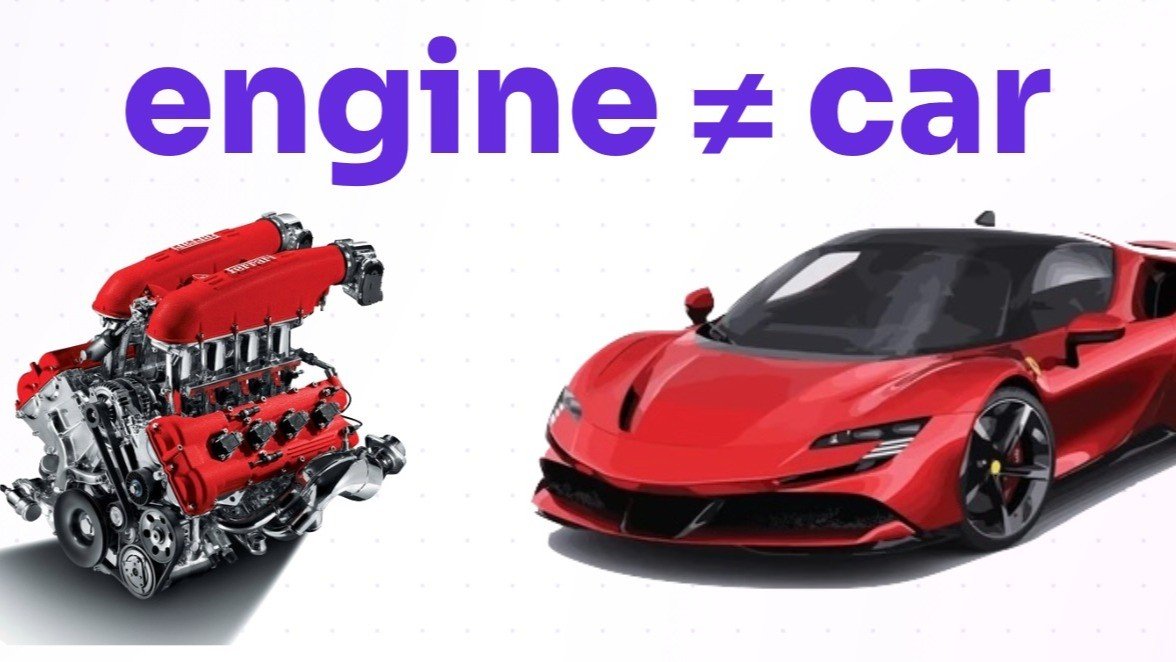
AI models like ChatGPT, Gemini or Claude are just the Engine. Enterprise AI needs a Car, not just the engine.
I spoke to over 15 CXOs and business function heads across manufacturing, finance and supply chain verticals and I am surprised with how consistent their first experience with AI for work has been. They downloaded ChatGPT or Gemini, experimented with a few work-related tasks, and came away unconvinced. The responses were impressive one moment and completely unreliable the next. The models hallucinated facts, overlooked important details, misunderstood context and often produced answers that required almost as much effort to verify as creating them from scratch. Their conclusion seemed obvious: AI is an interesting consumer technology, but it isn’t ready for serious business. I think they’re right about the experience but wrong about what they experienced.
Engine ≠ Car
The mistake is assuming that a general-purpose chatbot represents enterprise AI. It doesn’t. Judging enterprise AI by using an AI Chatbot is like judging a car by looking only at its engine.
An engine is an extraordinary piece of engineering. It generates power. It is the reason the vehicle moves. But no one buys an engine expecting it to take them from one place to another. Until it is integrated with a steering system, brakes, transmission, suspension, chassis and dozens of other components, it remains exactly what it is: raw capability. Consumers don’t buy engines. They buy complete vehicles that transform that raw capability into something reliable, predictable and one that can do the work.
Foundation models are remarkably similar. ChatGPT, Claude and Gemini chatbots are extraordinary engines for generating intelligence. They can read documents, interpret language, summarise reports, reason across large amounts of information and generate high-quality content. Yet none of these capabilities, impressive as they are, automatically translate into dependable business outcomes. An enterprise doesn’t need intelligence in isolation. It needs intelligence that operates within the boundaries of its business processes, policies, controls and governance.
This distinction explains why so many first experiences with AI are disappointing. A blank chat window asks the user to do far more work than most people realise. The user must define the objective, provide the relevant context, explain the constraints, supply the missing information and then judge whether the answer can actually be trusted. Every piece of organisational knowledge that a business application normally embeds has to be recreated manually through prompts. When the model inevitably fills the gaps with assumptions, the result is often inconsistent.
Businesses interpret that inconsistency as a failure of AI when, in reality, they are interacting directly with the engine instead of the finished vehicle.
Why do you need anything other than the engine?
Contrast this with almost any enterprise software application. A CRM already understands customers, opportunities and sales stages. An accounting system already understands ledgers, invoices and journal entries. A procurement platform already knows approval hierarchies, spending limits and vendor policies. The software feels reliable not because the underlying technology is inherently superior, but because years of product engineering have constrained the problem into a narrow, well-defined workflow. Every important assumption has already been built into the system before the user ever logs in.
Enterprise AI requires exactly the same discipline. The model should never be expected to carry the entire burden of producing a business outcome. Around it needs to be an engineered system that plays the role of the rest of the vehicle: organisational context in place of the fuel line, retrieval of the right documents as the steering, enforcement of permissions as the brakes, validated calculations and business rules as the transmission, and audit trails as the chassis holding it all together.
The model contributes intelligence. The surrounding system determines whether that intelligence can actually be trusted, and it also decides when to hand control back to a human, the equivalent of a driver taking the wheel when the road gets unpredictable.
This is also why AI slop is real, but often misunderstood. Large language models do hallucinate because they are built to predict the next word (aka token) using probabilistic algorithms and techniques. They may produce a different answer each time you ask the same question. Sometimes inconsistent answers too and might often miss critical edge cases. In regulated industries, those failures can have serious legal, financial or compliance consequences. Businesses are absolutely justified in refusing to deploy raw model outputs into production workflows.
But concluding that enterprise AI therefore cannot work is like concluding that automobiles are unsafe after merely listening to an engine hum. The lesson is not that the engine is useless but that the vehicle has not yet been engineered.
It’s worth being honest, too, that not everything sold today as “enterprise AI” deserves the label. Plenty of products are little more than a chatbot window slapped on top of an existing enterprise application. Businesses evaluating vendors need to look for the same underlying discipline this essay describes, not just the packaging.
Enterprise expectations
Consider contract review. A consumer chatbot can review almost any contract for almost any purpose because it has no understanding of what matters to your business. An enterprise system, however, should review only the types of contracts it has been designed for. It should compare them against the company’s approved clause library, identify deviations from standard language, cite supporting evidence, flag areas requiring legal attention and escalate only the genuinely ambiguous cases. The underlying intelligence may come from the same foundation model, but the business value comes from everything surrounding it.
Insurance underwriting follows the same pattern in a different setting. A generic chatbot asked to assess risk on an application has no memory of the insurer’s risk appetite, no access to historical claims data and no sense of which factors the company actually weighs. An enterprise underwriting system, by contrast, pulls in the applicant’s history, checks it against the company’s own risk models and pricing guidelines, flags the specific factors that fall outside normal tolerances and routes only the borderline cases to a human underwriter. Same engine underneath. Entirely different vehicle around it.
Consider a business workflow in Accounting, Closing year end books, Tax reconciliation, Audit, Claims processing, customer onboarding, enterprises rarely need an AI that knows everything. They need an AI that performs one workflow exceptionally well, within clearly defined boundaries, while integrating seamlessly with the rest of the organisation’s systems. General intelligence is valuable, but enterprise value is created by specialisation, constraints and workflow design.
Wrong direction
I believe many organisations are measuring AI from the wrong direction. They begin with the model and ask, “What can this do?” That question inevitably leads to scattered experiments, inconsistent results and disappointed executives.
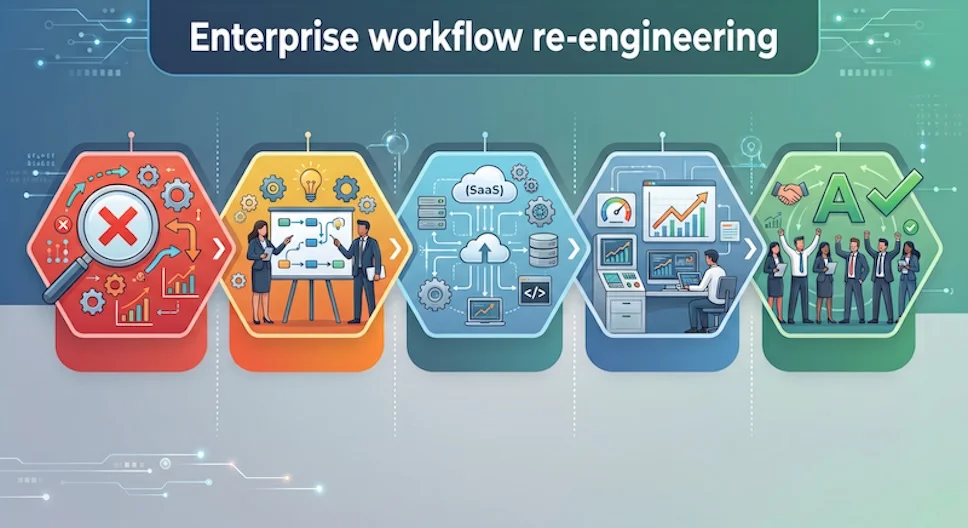
A better starting point is the workflow itself. Which business process is slow, repetitive, document-heavy and dependent on human judgement? Where are people spending hours gathering information from multiple systems, interpreting policies, documenting decisions and routing approvals? Those are the places where AI can fundamentally change the economics of work. The objective is not to insert a chatbot into an existing process. It is to redesign the process around machine intelligence.
That distinction may sound subtle, but it changes everything. Giving employees access to ChatGPT may help them write faster, summarise reports more quickly or brainstorm ideas more effectively. Those are worthwhile productivity gains. Re-engineering a workflow so that information is automatically gathered, relevant policies are retrieved, exceptions are identified, decisions are documented and approvals are intelligently routed is something entirely different. One makes an individual slightly more productive. The other changes how the organisation operates.
Risk of falling behind
Perhaps the biggest risk facing enterprises today is not that they adopt AI too slowly, but that they evaluate it incorrectly. If a company’s only experience with AI is through a generic chatbot, it is evaluating the engine rather than the car. That is an understandable mistake because consumer AI products are currently the most visible expression of this technology. But it is still a mistake.
The companies that create lasting advantage over the next decade will not necessarily be those with access to the most powerful models. Those models are rapidly becoming commodities. The advantage will belong to organisations that learn how to engineer complete systems around them, that understand where intelligence should be applied, where deterministic software should take over, where humans should remain in control and how workflows should be redesigned to combine the strengths of all three.
The next time someone says, “We tried ChatGPT and it wasn’t good enough for our business,” my response is simple. You didn’t evaluate enterprise AI. You evaluated the engine. The real question isn’t whether the engine is powerful enough. The real question is whether you’ve built the car.
About bryks.ai

bryks.ai deploys Re-Engineers to redesign manual, compliance-heavy workflows as AI-native automations, unlocking operating leverage.
We have helped businesses and their CA firms with Direct Tax (TDS), Indirect Tax (GST) and Audit workflow automations which save them upto 40-50 hrs of manual work per client, while also reducing the error rate by 90%.
Visit www.bryks.ai to schedule a free 30-minute audit call. We identify your highest ROI manual workflows, and redesign them grounds-up so that it can take full